

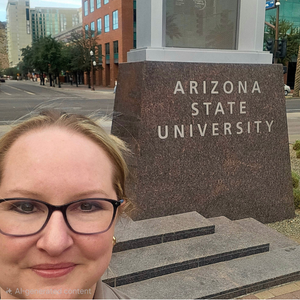
Last week, I had the opportunity to visit Arizona State University (ASU) as part of a counselor visit. Before the visit, I would have said ASU was a party school by reputation and a large student mill. I have to admit that I was wrong.
Some may say I drank the ASU Kool-Aid, but here’s why I think Texas students should take another look at ASU.
5 Reasons Why Texas Students Should Consider ASU
1. Clear admission requirements
If you’ve met ASU’s course competency requirements, which most Texas high school graduates will, you need to meet ONE of the following requirements for admission:
- Top 25% in high school graduating class
- 3.00 GPA in competency courses (unweighted)
- 1180 on the SAT® test or 24 on the ACT® test
Although there are slightly higher requirements for students looking to major in some programs—such as business, engineering, or nursing—those requirements are clearly laid out and guarantee direct admission into a major.
While admission at some public Texas colleges can feel like a lottery, especially at the most competitive schools, I appreciate the transparency ASU gives potential students.

2. Barrett, The Honors College
For 8,000 high-achieving students at four ASU campuses, Barrett Honors College offers a smaller community within the larger campus. You’ll find nine buildings at the Tempe campus dedicated to these students, including a dining hall and dorms nicer than most I have seen.
Students receive support from a major advisor, an honors advisor, and a faculty honors advisor, ensuring that there is always someone to reach out to with questions.
Barrett offers smaller class options—honors sections average 25 students—and a special living environment. The Human Event requirement is a conversation-based, interdisciplinary course with no more than 21 students. Yes, all Barrett students complete an honors thesis, but don’t let that scare you. Most students work with two to three mentors to complete the project, and it can even be done with a group.
With special Barrett scholarships, global Barrett study abroad opportunities, and a high level of support, strong students should definitely consider applying to Barrett.
3. Flexibility when changing majors (even in business and engineering)
When you are accepted into a major at The University of Texas at Austin or Texas A&M University, it is notoriously hard to change majors—especially switching into business and engineering.
How are 17- and 18-year-olds supposed to know whether they want to study mechanical engineering or electrical engineering without extensive experience in both? Texas A&M has tried to address this issue by requiring all engineering students to participate in a year of common curriculum, then “apply” to their desired major. But what happens when you don’t get into your desired major? Do you stay at Texas A&M and study something you aren’t excited about, or do you try to transfer to a new university and start all over again?
ASU allows students to switch seamlessly from one major to another within the same college, without roping off popular options. For most teenagers, this flexibility should provide some comfort if you don’t have your entire life planned out (and who expects you to?).
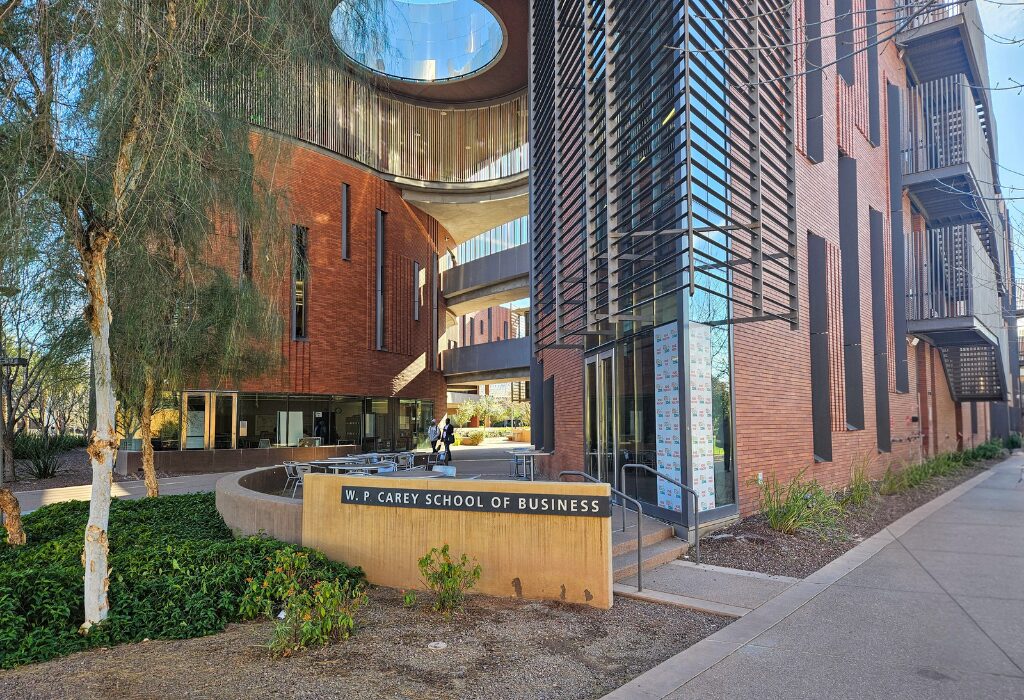
4. Focus on innovation and interdisciplinary opportunities
If you spend even one day on ASU’s campus, it is inevitable that you will hear the school is ranked #1 in innovation by U.S. News & World Report. The claim is plastered on signs, flyers, and mentioned in almost every prospective student presentation. But what does this mean for students?
Whether students are using virtual reality to learn biology and chemistry (shoutout to Dreamscape Learn at Tempe!) or creating their own seawater for experiments at the School of Ocean Futures, you’ll find the spirit of innovation throughout the campus. I even met an aerospace engineering student who is building prosthetic limbs for children through Devil Prosthetics.
The interdisciplinary opportunities offered by ASU rival those of much smaller universities that allow students to mix and match to create a truly unique degree. Be on the lookout for some surprising offerings from ASU Health in the coming years with the opening of their new medical school!
5. You’re more than a number
With more than 140,000 students across five campuses and online programs, it would be easy to assume that a place like Arizona State University feels impersonal. But that hasn’t been my experience at all.
ASU intentionally builds smaller communities within a large university. Whether they are participating in Barrett, joining clubs, or getting assistance through Student Accessibility and Inclusive Learning Services (SAILS), students have access to top-notch facilities and professors.
Struggling to understand who gets in and why, Texas students often feel like one application in a massive pile. ASU offers them an alternative: clarity in admissions, flexibility, and a culture that values initiative and individuality.
Need help selecting colleges?
KD’s college counseling programs connect students with admissions experts who support them through every step of the admissions journey. The APPLY NOW! Advantage Program, KD’s best-value college counseling solution for 9th-11th grade families, includes activities and personal guidance opportunities that students can use to explore college options and choose where to apply.
To learn more about how our programs can help your student, schedule a free consultation with a member of our team.